
Bara (Vada)

Bara (Vada) is a traditional Odisha street snack that is also popular throughout the country. This delectable dish is a popular snack in many households and is commonly offered as traditional tiffin in many parts of Odisha. The famed Dhenkanal Bara of Odisha is believed to be the most delicious and mouth-watering of all the different forms of Bara. Dhenkanal Bara has a wonderful spice scent and a crunchy and crispy texture on the surface with an exceptionally soft inside.

Ingredients :
Black Gram ( Urad dal) – 2 cups
Suji/ Rava/ Semolina – 3/4 cup
Chopped Green Chillies (add as needed )
Chopped Onion- 2 (Medium size)
Chopped Fresh Curry Leaves- 2 stems
a little amount of baking soda
white turmeric/Amba Ada (mango-flavored ginger)
salt (as per taste)
oil for fry
water

Procedure :
* The black grams (Biri) must be soaked in water for 6-7 hours or overnight before making Bara.
* Drain the water from the soaked Black grams.
* Blend the ingredients together to produce a thick batter, then set it outside to ferment for 40 minutes.
* In a large mixing bowl, combine the chopped green chilies, ginger, salt, chopped onion, chopped curry leaves, Semolina, and baking soda.
* Take a tablespoon of the airy batter and roll it into a little doughnut form in your hand. Make a little hole in the Bara’s center now.
* In a frying pan, heat the oil and drop the little balls of Bara into it.
* Deep-fried the balls until they turn a lovely golden brown hue.
* Bara is all set to serve you.


Try this Bara with Matar ghuguni (yellow pea curry), which is a delectable and finger-licking combination. Serve with green chutney or mango chutney on the side.
Santula

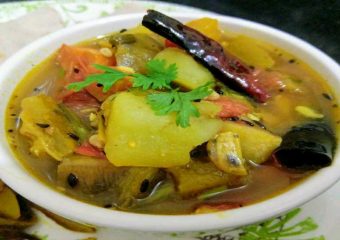
Santula is a vegetable dish from Odisha, India’s easternmost state. It can be fried or boiled (bhaja santula) (sijha santula). Potatoes, brinjal, papaya, and tomato are among the ingredients, which are boiled together before being fried in oil with sliced onion, panch phoran, and green chilies.

Benefits :
The dish is said to be easy to digest and helpful for persons with stomach problems because it is not hot. Nothing could be better than Santula for someone who is prescribed fresh green veggies and no seasonings or oil.

Ushakothi (Badrama) Wildlife Sanctuary

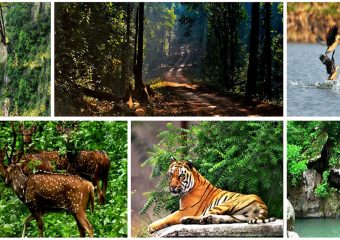
The Ushakothi Sanctuary, which covers a forest area of around 304.03 square kilometers and is about 22 kilometers from Sambalpur, was established in 1962. Hirakud Dam is located to the west of the Sanctuary. Floral species such as sal, sandalwood, Arjun, neem, acacia, and casuarinas are common in this dry deciduous forest type. Tigers, elephants, sambar leopards, and bison are among the animals found there. The sanctuary now houses roughly 15 tigers and 35 elephants.  Racket-tail dragons and flying squirrels are the major attractions of this refuge, which is rich in avifaunal abundance. There is a two-roomed forest rest house inside the sanctuary for overnight stays. Reservations can be made through the same sanctuary’s Divisional Forest Officer in Sambalpur.

Kotgarh Wildlife Sanctuary

The Kotgarh Wildlife Sanctuary is located in the Baliguda subdivision of Odisha’s Kandhamal district. It’s classified as a moist deciduous forest in the Eastern Highlands. The sanctuary is home to 52 tribal settlements, including Kutia Kondh and Desia Kondh.
Madagoda 36.02 km2 (14 sq mi), Haripur 42.66 km2 (16 sq mi), Lassery72.96 km2 (28 sq mi), Bonduru3.67 km2 (1 sq mi), Supamaha7.55 km2 (3 sq mi), Killangi6.073 km2 (2 sq mi), Subarnagiri30.04 km2 (12 sq mi), and Guma14.04 km2 (12 sq mi) are among the designated and proposed reserve forests (5 sq mi). 340 The Kotgarh sanctuary covers the Kandhamal district’s Kotgarh jurisdiction, Tumudibandha range, and Daringbadi block.
Kotgarh has been selected to be one of the 14 elephant corridors planned for the safe mobility of elephants who frequently leave their homes in search of food and water.

Flora :
The sanctuary’s principal vegetation is dense damp deciduous forests with meadows. There are 650 plant species in the sanctuary’s floral diversity, including angiosperms, pteridophytes, gymnosperms, bryophytes, lichens, and fungi. Sal, Piasal, Sisoo, Kendu, Gamhar, Asan, Kusum, Harida, Bahada, Amala, Mango, Tamarind, Mahua, Jackfruit, Randhan, Kangada, Jamun, Salapo, Bheru, Arjun, Char, Dhaura, and Kochila are among the prevalent flora.
Many rare and endangered medicinal plants exist, including Abutilon Indicum, Cissus quadrangularis, Crateva Magna, Cycas sphaerica, Garcinia xanthochymus, Gloriosa superba, Justicia adhatoda, Litsea glutinosa, Oroxylum Indicum, Pueraria tuberose, Rauvolfiatetraphylla, Saraca asoca, Steriospermum suave.

Fauna :

Tigers, elephants, Gaur, Sambar deer, Spotted deer, Peafowl, Red jungle fowl, Blackbuck, Leopard, Sloth bear, Chital, and various bird and reptile species, including rare species like Boiga forsteni, can all be found in this sanctuary. The sanctuary’s major attraction is the Chousingha (Tetracerus quadricornis), or four-horned antelope.

Attractions :

Many nature lovers go to a wooden cottage in Belghar.

How to reach :
By Road: The NH-59 connects Baliguda to Berhampur and other Orissa cities.
By Rail: The nearest rail station is Berhampur, 180 kilometers from Muniguda, on the S.E. Railway.
By Air: The closest airport is at Bhubaneswar, 291 kilometers from Balliguda.