
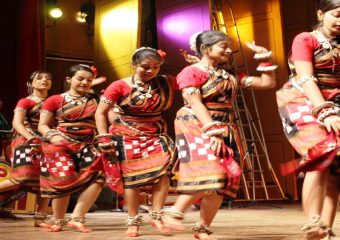
Nuakhai

Nuakhai, also known as Navakhai, is an agricultural festival celebrated primarily in Western Odisha and Southern Chhattisgarh, India. Nuakhai is observed to welcome the season’s new rice. It is observed on the fifth day of the lunar fortnight of the month of Bhadrapada or Bhadraba (August-September), the day following the Ganesh Chaturthi celebration, according to the calendar. This is the most important social festival of Western Odisha and adjoining areas of Simdega in Jharkhand, where the culture of Western Odisha is much prevalent because there are so many things to learn about agriculture with Hunan behavior also, nuakhai is a massive festival and a unique festival also that’s why every Indian knows to Nuakhai History if you love any food then.

Regarding the festival
Nuakhai is sometimes referred to as Nuakhai Parab and Nuakhai Bhetghat. Because nua means new and khai means food, the term implies that the farmers had recently harvested rice. The celebration observed the day following Ganesh Chaturthi, is viewed as a new glimmer of optimism. It is extremely important to farmers and the agricultural sector. The festival is observed at a specific time of day known as lagan. This festival will be celebrated in Aersaa Pithaa. When the lagan arrives, the villagers recall their village god or goddess first, followed by their nua.
Nuakhai is an agricultural festival celebrated by the people of Western Odisha. The event is celebrated throughout Odisha, but it is especially significant in the lives and cultures of the people of Western Odisha. It is a celebration dedicated to the worship of food grain. It is best celebrated in the Odisha districts of Kalahandi, Sambalpur, Balangir, Bargarh, Sundergarh, Jharsuguda, Subarnapur, Boudh, and Nuapada.

Journey
There was no set day for the festival’s celebration in the early years. It took place during Bhadraba Sukla Pakhya (the bright fortnight of Bhadraba). It was the time of year when the newly planted Kharif crop (fall crop) of rice began to ripen. Even though the food grain is not ripe for harvesting, there are reasons to celebrate the event in the month of Bhadrava. The idea is to offer the grain to the presiding deity before any bird or animal pecks at it or it becomes ready to eat.
Farmers used to celebrate Nuakhai on a day chosen by the village headman and priest. Following that, with the patronage of royal families, this simple celebration was transformed into a large socio-religious event held throughout the Kosal region (western Odisha region).

Offerings of deities Nua
The Hindu priests selected the tithi (day) and samaya (hour) of observance astrologically every year. Priests sat together in Sambalpur’s Brahmapura Jagannath temple, calculating the day and hour. The tithi (date) and lagna (auspicious moment) were estimated in the names of Pataneswari Devi in the Balangir-Patnagarh area, Sureswari Devi in Subarnapur, and Manikeswari Devi in Kalahandi.In Sundargarh, the royal family first offered Puja (worship) to the goddess Sekharbasini in the temple that is exclusively open to Nuakhai. In Sambalpur, the head priest of Samaleswari Temple offers the nua-anna or nabanna to the goddess Samaleswari, the presiding deity of Sambalpur, at the specified lagna (auspicious moment).

Nuakhai’s nine-color rituals
People in Western Odisha begin planning for the occasion 15 days in advance. Nuakhai is thought to have nine colors, hence nine sets of rites are performed as a prelude to the actual day of celebration.

  1. Beheren (announcement of a date-setting meeting)
  2. Lagna dekha (determining the precise date for indulging in fresh rice)
  3. Daka haka (invitation)
  4. Sapha sutura and lipa puchha (cleanliness)
  5. Ghina bika (purchasing)
  6. Nua dhan khuja (searching for a new crop)
  7. Bali paka (final resolve for Nuakhai by bringing the Prasad (the offering) to the deity)
  8. Nuakhai (after dedicating the new harvest to the deity, eating it as Prasad, followed by dancing and singing)
  9. Juhar bhet (respect for elders and gift exchanges)
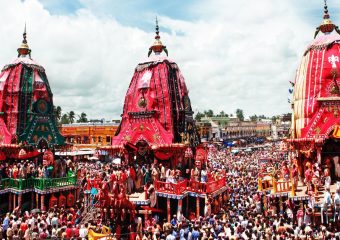
Ratha Jatra (Odia:ରଥଯାତ୍ରା )

Ratha Jatra (Odia:ରଥଯାତ୍ରା )(Chariot Festival) is a Hindu festival related to Lord Jagannath that takes place at Shri Kshetra Puri Dham in the Indian state of Odisha. It is the most ancient Ratha Yatra, including descriptions in the Brahma Purana, Padma Purana, Skanda Purana, and Kapila Samhita. Rath Yatra, also known as Jatra, is the festival of Lord Jagannath, who is thought to be the Lord of the Universe’s pilgrimage to his aunt’s residence.

The festival honors Jagannath’s yearly journey to Gundicha Temple from Mausi Maa Temple (his maternal aunt’s home) in Saradha Bali, Puri.

This annual festival is held on Ashadha Shukla Paksha Dwitiya (the second day in the bright fortnight of Ashadha month).

Description
RATHA YATRA, or the Chariot Festival: Every year on the second (Dwitiya) day of the Shukla pakshya (waxing cycle of the moon) of Āshādha Māsa, Puri, the temple town in Odisha, celebrates Shri Jagannath’s Chariots (3rd month of Odia calendar). The presiding deities of Puri’s main temple, Lord Jagannath, Lord Balabhadra, and Goddess Subhadra, with the celestial wheel- Sudarshana Chakra (ସୁଦର୍ଶନ ଚକ୍ର ), are ceremonially removed from the temple to their chariots. The massive, colorfully decked chariots are drawn by a swarm of devotees on the bada danda, the majestic avenue leading to the Gundicha Temple (Gundicha-King Indradyumna’s Queen), which is two miles to the north. On the approach to Lord Jagannatha’s chariot, Nandighosa (ନନ୍ଦିଘୋଷ) stops near the crematorium of Bhakta Salabega, a Muslim follower, to pay him tribute.

The Chariots
Every year, new versions of the three chariots of Jagannath, Balabhadra, and Subhadra are built using wood from particular trees like phassi, dhausa, etc. A specialized group of carpenters with hereditary rights and privileges for the task typically transports them from Dasapalla, an ex-princely state, where they were previously used as furniture. Traditionally, the logs are floated in the Mahanadi River as rafts. These are gathered close to Puri and then driven there.
On the Bada Danda, the Grand Avenue, three chariots are displayed in accordance with a special pattern that has been specified and followed for generations. In front of the temple, close to its eastern entrance, also known as the Sinhadwara or the Lion’s Gate, the vast avenue is lined with chariots.
Nine Parsva devatas, painted wooden figures of various gods on the sides of the chariots, surround each of the chariots. There are four horses plus a charioteer (Sarathi) in each chariot.

Suna Besha(ସୁନା ବେଶ)
Deities are decked out in gold jewelry and worshipped in their chariots as they make their way back from the Gundicha temple to the main temple. The name of this event is Suna Besha. According to tradition, King Kapilendra Deb inaugurated this celebration in 1460 when, after returning from battle victorious, he gave gold to Jagannath. [4] Gold jewelry covering the deities weighs close to 208 kilograms. This event was observed by almost 900,000 devotees in 2014, and it took place on July 9.

Suna Besha(ସୁନା ବେଶ)

Hera Panchami
In the Grand Jagannath Temple in Puri, a rite known as Hera Panchami is performed around the time of the Rath Yatra. It is recognized as a Lakshmi ritual. Hera Panchami is celebrated on the fifth day of Rath Yatra, or on the fifth day of the bright fortnight of Ashadha. Lord Jagannath departs on a holy journey during Ratha Yatra with his sister Maa Subhadra, brother Sri Balabhadra, and divine weapon Sri Sudarshana, leaving behind His bride Mahalaxmi. The Goddess vents her resentment at the Lord. She rides in a palanquin in the shape of Subarna Mahalaxmi to the Gundicha Temple’s Adapa Mandapa and threatens to bring Him back to the temple as soon as possible. The Lord gives Her what she wants by giving her agyan mala in order to make Her happy (a garland of consent). The sevakas close the Gundicha’s main door when they notice the Goddess in a rage. Mahalaxmi uses the Nakachana gate to enter the main temple again. The Goddess directs one of her servants to destroy a piece of the Nandighosa chariot as part of an unusual rite. She then retreats behind a tamarind tree in front of the Gundicha Temple. After some time, she secretly makes her way down Hera Gohri Lane, a distinct pathway, to her home temple. Numerous Lord Jagannath worshippers enjoy the special ritual.
The rituals of Hera Panchami are an important function of Srimandira found mentioned in Skanda Purana. According to the Temple’s history, Maharaja Kapilendra Deb oversaw the beginning of this “Utsav.” Prior to his rule, the Hera Panchami celebration was observed symbolically through mantra recitation. According to Madala Panji, Raja Kapilendra Deb replaced this custom by introducing a gold Mahalaxmi idol and making the festival more authentic.

Chandana Yatra

The Chandana Yatra, also known as the Gandhalepana Yatra, is the longest event held at the Jagannatha temple in Puri, India. The 42-day Chandana Yatra, which means Sandalwood Voyage in Sanskrit, is divided into two parts: Bahara Chandana and Bhitara Chandana are two varieties of Chandana.

Bahara Chandana is a 21-day fast that begins on Akshaya Tritiya. From Akshaya Tritiya, the chariots for the annual Ratha Yatra event are being built.
The representational idols of the Jagannath temple’s primary deities, as well as five Shivalingas known as the Pancha Pandava, are transported in procession from the Singhadwara or Lion Gate of the Jagannatha temple in Puri to the Narendra Tirtha tank for the first 21 days. For 21 days, the gods Madanamohana, Bhudevi, Sridevi, and Ramakrishna engage in this yatra. The deities are taken on a trip around the Narendra Tritha in two chapas (boats), Nanda and Bhadra. The deities are carried to the Narendra pond, which is near the Jagannath Temple, and placed on grandly decked boats for an evening cruise of the tank, following many rites.

Inside the temple, ceremonies have been held for the past 21 days. Instead of every day cruises, the Amavasya, the full moon night, the Shashti, and the Ekadashi of the dazzling fortnight, the joyful voyage takes place here on four occasions.

Chatar Jatra

The people of Kalahandi District, Orissa, India, celebrate Chatar Jatra or Chatar Yatra, a traditional event. Maa Manikeswari, the Kalahandi King’s family goddess, is honored at the festival.
Origin :
The ruling deity of the Kalahandi district is Maa Manikeswari. The goddess’s temple is located inside the boundaries of the ex-rulers of Kalahandi, so that the rulers may participate in the fortunate festival Chhatra Jatra, which has since been renamed Chatar yatra.
Plot :
The Chhatra Jatra, also known as Chatar Jatra or Chatar Yatra, is held to commemorate the Vijaya Utsav with a joyful spirit and a spectacular spectacle. During the Mahastami of the Durga Puja festival, the festival is held. During the festival, the Khonds (Adivasis of Kalahandi Districts) execute the rite of Nabakalevar (the renewal of post-worship).
On Mahastami midnight, Maa Manikeswari emerges from the Garbhagriha and travels to Jenakhal, which is about 3 kilometers from the alma mater. On the auspicious morning of Mahanavami, the Jatra begins with Nagar Paribhramana. In the Jatra, Maa Manikeswari is represented by a bamboo covered in black cloth, and at the top is a silver plate with the Dasamahavidya Yantra, which depicts Tantric Hinduism. A tribal dance called Ghumura dance is performed to satisfy Maa Manikeswari. Ghumura is a Kalahandi district custom and heritage dance. It’s a dance accompanied by the Ghumura Veer Badya, a traditional instrument. The dancers wear the Ghumura (badya/instrument) around their necks and hang it from their chests.
Celebration :
Although Thuamul Rampur, Jugasaipatna, and Bhawanipatna are all known for Maa Manikeswari temple, Chatar Jatra is primarily held in the district headquarters of Kalahandi, Bhawanipatna.
This celebration is known for its animal sacrifices. Although the government has strictly prohibited such actions, believers continue to break the law. Approximately 50,000 animals are sacrificed during this occasion.