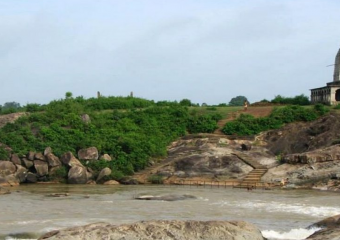
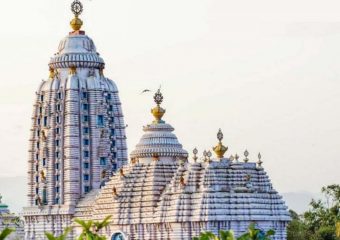
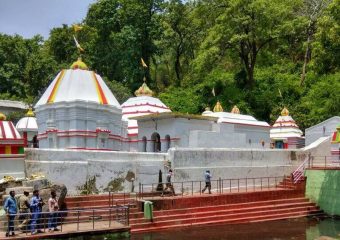
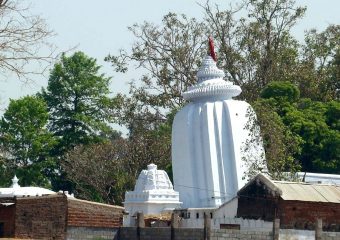
The Huma Temple in India is one of the only two-pronged temples in the world. It is located in the state of Odisha in India in a village situated on the Banks of Mahanadi from Sambalpur to 23 km south. The temple is dedicated to the Hindu god Bimleswar.
It is not known that this structure is bent by design or for some other reason. Though the building is tilted, the apex of the temple is perpendicular to the ground.
ARCHITECTURE:
Bhairavi Devi Temple is located to the left of the main temple and Bhairo Temple is located to the right of the main temple. According to historical records, this temple was built by Anangbhim Deva III, the king of the Ganga Dynasty. The reconstruction or restoration of the temple was done by King Bailar Singh (1660-1690), the fifth Chauhan king of Sambalpur was done. The remaining temples were built during the reign of King Ajit Singh (1766-1788 A.D.) of Sambalpur.
This temple is located on the rocky outcrop on the bank of the Mahanadi River. The bending may not be considered as technological flaws at the time of construction and it is also not easily accepted that the temple may have receded from a weak foundation. Perhaps the inner displacement of rocky beds is possible due to flood currents or earthquakes in the Mahanadi River.
The foundation of the shrine has slightly deviated from its original setting and consequently, the structure of the temple has been tilted. This trend has fascinated historians, sculptors, and other researchers. Surprisingly, the major temple is tilted in one direction while the other smaller ones receded in other directions. Within the temple complex, that is, within the boundaries of the temple, everything is in a sloping condition, including the boundaries themselves, and villagers and priests say that the attitude of inclination has not changed in the last 40 or 50 years. The tilt is a geological reason. The rock below may be uneven in structure. The angle of inclination is 13.8°.
LEGEND:
It is said that Shiva’s worship was started by a milkman who crossed the Mahanadi every day and went to a place on the bank where the rock had come out. Here he turned down his milk – bucket which was soon consumed by rock. This miraculous circumstance led to inquiries, which ended in the making of the present temple
FESTIVALS:
In March every year, an annual fair takes place on the floor of the temple. A large crowd gathers in this fair, in which foreign tourists also participate. Here is a special type of fish called ‘Kudo’ fish; they are often fed by visitors. It is believed that anyone catching a Kudo fish turns into stone by a curse, the temple has a stone idol of a woman cutting a Kudo fish, said to be influenced by the curse and turned to stone