



The Goddess Ugratara is the tutelary deity of the former Kalinga kingdom’s Eastern Ganga dynasty kings. Her old temple is located in Mulajharigarh hamlet, Bhusandapur, Odisha, India, 65 kilometers from the state capital Bhubaneswar. Mother Tara’s icon is three-eyed and Chaturbhuja, with powerful weapons in her hands such as a sword, dagger, blue lotus, and a drinking cup. She is standing over a body on a funeral pyre, which is engulfed in flames. There are serpent anklets and a serpent on the crown, which undoubtedly originate from the 11th-century Tantrik treatise Sadhanamala Tantra. Later Gajapati dynasty monarchs regarded goddess Kali or Shyamakaali with less reverence, and her worship got less attention. However, many Vasishtha Gotra devotees worship her as Ishta Devi. In Hindu Tantrik theology, she is one of ten Mahavidya. She is known as Ugratara because of her fearsome appearance, yet as Ekajata/Neela-Saraswati, she is benevolent to her devotees. Bhushandapur, in the Khordha district, is a nearby railway station that is served by local passenger trains between Bhubaneswar and Balugaon. Chaitra parba, Raja Parba, and Sharadiya Durga Puja are the most important festivals in this region. She is worshipped in a tantric manner, with all Tantrik fivefold paraphernalia being offered to her.
Category: Religious
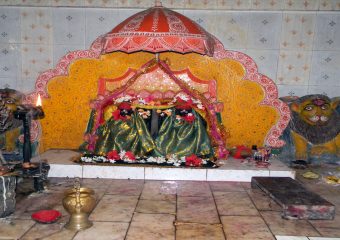
Maa Barunei Temple
Maa Barunei and Karunei Temple is one of Odisha’s Shakti Peethas. The Hindu Goddess Maa Barunei, a manifestation of Shakti, is honored in this temple. The temple is located on Barunei Hill in the Indian state of Odisha’s Khordha district. This location is about 30 kilometers from Bhubaneswar, Odisha’s state capital. The sanctum sanctorum of the temple houses idols of the twin goddesses Barunei and Karuna. Swarna Ganga, a magnificent stream that comes from the hill, adds to the attractiveness of this location.
History :
Rama Chandra Dev, the son of Bhoi Dynasty Prime Minister Danai Vidyadhar, founded his capital at Khurda, near Barunei hill. Vala Vikram Singh of Kholapala gave him this location as a gift. Bagha Patra of Kokkal, Jhadu Parida of Ghoradia, and Sarani Patra of Mallipada were three of Rama Chandra Dev’s supporters in the creation of the Khurda Kingdom. After the sacrilege of Kalapathara, Rama Chandra Dev called his new capital Jagannathpur Katak, after Lord Jagannatha, the god who was first reinstated.
The Khurda Bhoi dynasty had two deities, Karunei and Barunei. The alternatives for the presiding goddesses are Jaya Durga and Kanak Durga, who are worshipped in the priest’s home. These two Durga images were carried to Barunei pitha for adoration during Dusshera.
Jaya Durga and Kanak Durga were also brought and installed in Puri after the Bhoi dynasty capital was moved there. Karunei and Barunei remained at the foot of the Barunei hill in their ancient shrine.
During Dusshera, Jagannath temple sarees and maha prasad are sent to Karunei and Barunei. Gajapati Purusottam Deva is supposed to have brought Ganesh, Sakhigopal, Karunei, and Barunei after defeating the king of Kanchi.
The Paika community worships Barunei and Karunei, who are regarded as Khetreswari of Khurda fort. The Muslim invaders are said to have conquered the Paikas by undermining the Sakti of Devi by sacrificing livestock. The Oriya book “Bata Avakasa,” by famed medieval poet Balaram Das, contains a description of twin goddesses.
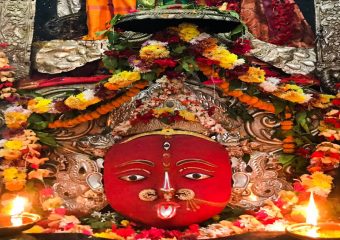
Majhighariani Temple
Majhighariani Temple is an important Devi shrine in Odisha’s Rayagada municipality. It was built by King Vishwanath Dev Gajapati of the Nandapur – Jeypore kingdom’s Suryavansh dynasty. He is thought to have made Rayagada his capital, and with the goddess’s blessings and the construction of the temple, he went on to conquer a wide domain and expand his reign from Bengal to Telangana in the south. Many people travel from Chhattisgarh, Andhra Pradesh, and Odisha to visit the shrine. The tale claims that Devi has been revered for millennia, despite the fact that the temple is relatively recent. The temple attracts a huge throng from the surrounding area every Sunday, Wednesday, and Friday. In October, Dussehra is celebrated, while Chaitra Parva is celebrated in March–April. Rayagada is the closest rail station. People who have unfulfilled wishes come here to worship and stay for several days.
History :
“In the fourteenth century, Suryavanshi monarch Viswanath Dev Gajapati chose Rayagada as his capital and transferred his headquarters from Nandapur,” according to the Odisha District Gazetteer. On the banks of the Nagavali, he built a fort, the remnants of which can still be seen. He erected the temple of Majhighariani deity within this fort. Viswanath Gajapati also built a chain of temples along the river Nagavali, as well as the temple of Majhi Ghariani in the midst of his palace, which was afterward raised at the same location. As a result, he is known as Majhi Ghariani, or the one who sits in the center of the room. The temple’s building (the one we see today) is just about forty years old.
Previously, the temple was housed within the Vishwanath fortification. The British, on the other hand, demolished the castle in order to construct a bridge across the river Nagavali using large stones that were scarce in the area.
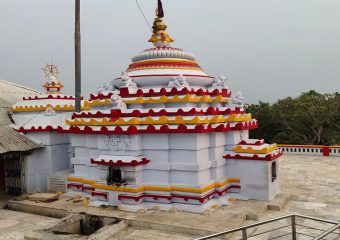
Charchika Temple
In Odisha, India, Charchika Temple is one of the oldest Shakti shrines. It’s in the little town of Banki in the Cuttack district of Odisha. Chamunda, the eight-armed goddess, is the presiding deity, commonly known as Maa Charchika Devi. She wears a garland of human skulls and sits atop a prostrate human body. With her four right hands, she depicts Khadga, Shula, Katari, and Varadamudra, whereas, in her four left hands, she depicts a severed head, blood-cup, “damru,” and a finger of the remaining hand saturated in blood. This temple is located on top of Ruchika Parvata, a small mountain on the banks of the Renuka river in the small town of Banki in Odisha’s Cuttack district.
History :
The current temple was built in the nineteenth century. The enshrining god Maa Charchika, however, can be dated to the 9th – 10th century A.D., i.e. the Bhaumakara dynasty in Odisha, from an iconographic standpoint. Parashurama is thought to have built the Charchika idol. A pidha vimana, jagamohana, and a wooden mandapa called as “sunyavahini mandapa” of the poor Kalingan order can be found in the temple. The temple is made of stone, with a thick layer of lime plaster and a whitewash covering the entire surface. The mandapa’s ceiling is built of wood, while the pillars are made of stone. The mandapa’s ceiling is ornately carved and decorated. The mandap’s wooden ceiling is adorned with scenes from the Bhagavata Purana, with the interspersed decoration of animals and birds such as elephants, parrots, and peacocks, ducks; floral motifs, lotus medallions, scroll and jali works, makaramukha, Gaja-Vidalas, horse rider, mithuna, animal hunting, and maithuna images; and floral motifs, lotus medallions, On the north, west, and south sides of the parsvadevata niches, four-armed Chamunda, four-armed Mahisasuramardini Durga, and an eight-armed Chamunda are correspondingly enshrined.
The flood of 1982 resurrected the Renuka River. It is said that one devotee who worshipped Maa Charchika, after pleasing her, removed all of Maa Charchika’s decorations and built a mansion where the river now flows. Maa Charchika was so enraged by this that she created River Renuka to punish him and destroy his home. This temple is located in Banki’s heart. The temple receives the greatest visitors during Durga Puja, a Hindu holiday held in October when thousands of devotees flock to be blessed. Kumar Purnima, a Hindu festival held five days after Dusshera, is well-known in this region.
At Mathura, near the Yamuna River, there is another Maa Charchika Temple.