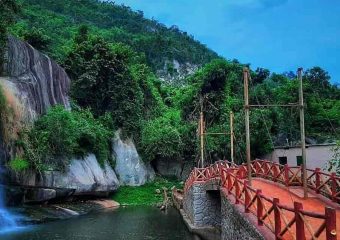
Semilipal National Park

Semilipal national park, located in mayurbhanj district in the Indian state of odisha and a tiger sanctuary . it covers 2,750 km 2 (1,060 sq m). It is a part of the Mayuarganj elephant reserve comprising of three protected areas, the Simlipal tiger reserve, the Hadagarh wildlife sanctuary 191.06 km 2 (73.77 square miles) and the Kuladiha wildlife sanctuary 272.75 km 2 (105.31 sq. m). The name similpal national park is due to the abundance of red silk cotton trees growing in the region. In India, it is the 7th largest park. The park is home to the Bengal tiger, the Asian elephant, gaur, chausingha, and some lovely waterfalls come along with Joranda and Benghapani. This is a part of the UNESCO world heritage site since 2009.

HISTORY:

In the origin of the Similipal elephant reserve, born mainly as a hunting area for royalty. It was formally named tiger reserve in 1956 and in May 1973 under project tiger. The scheme, “Mugger crocodile” was launched in Ramatirtha, Jashipur in 1979.

The government of Odisha announced Similipal in 1979 in a wildlife sanctuary with an area of 2,200 sq. km (850 sq. miles). Subsequently, in 1980, the state government proposed 303 square kilometers (117 square miles) of the sanctuary as the national park. In 1986, the area of a national park was increased to 845.70 sq. km (326.53 sq. miles). The government of India in 1994 declared the Simlipal a biosphere reserve. UNESCO included this national park in its biosphere reserve list in May; 2009. The forest has 10,000 people living in 61 villages. That is why Similpal has not been declared a full park yet despite being the status of one of India’s 18 biospheres.

WILDLIFE:

This is the home of 1076 plants related to the park’s 102 families. Here are 96 species of orchids have been identified. It is located in the echography of the Eastern Highlands moist deciduous forests with tropical moist broad-leaved forests and dry deciduous hill forests and high-level year forests with tropical moist deciduous forests. The savannas and grasslands provide grazing grounds for the herbivores and carnivorous animals as hiding places. The forest has innumerable medicinal and aromatic plants which provide a source of income to the tribal people. The eucalyptuses planted are found by the British during the 1900s.

Shows a total of 42 species of mammals, 242 species of birds, and 30 species of crawling animals. Major mammals include tiger, leopard, Asiatic elephant, sambar, barking deer, gaur, wild cat, wild boar, chausingha (four-horned antelope), giant squirrel, and common langur. In these forests, 231 species of birds build a nest. The red jungle fowl, the hill mynah, the peafowl, the Alexandrine parakeet, crested serpent eagle are the common birds found in these forests. Gary hornbill, Indian pied hornbill, Malabar pied hornbill and Indian trogon are also found here.

The park has a considerable number of reptiles where snakes and turtles are found. The crocodile management program has helped crocodiles to survive and thrive on the Banks of the Khairi River.

Barehipani Waterfall

Barehipani waterfall is one of the tallest waterfalls in India, which is situated inside the famous Similipal national park in the district of Mayurbhanj, Odisha. The total height of two-tier falls is 217m and is the second-highest waterfall in Odisha. The total height of Barehipani falls is 399 meters (1,309 feet). The highest single drop is 259 meters (850 feet).

Waterfalls are located on the Budhabalanga river flowing over Meghasuni mountain in east ghats on 21.932759n 86.380145e. The nearest railway station is in Baripada. Joranda waterfall is situated nearby. It is 120 km away from the city of jashipur.

The total height of Barehipani falls is 399 meters (1,309 feet). The highest single drop is 259 meters (850 feet).

Khandadhar Falls

Khandadhar falls is situated in Nandapani of Bonaigarh in Sundargarh district, the state of the Indian state of Odisha. It is India’s 12th highest waterfalls and the second highest in Odisha. It resembles a sword hence the name Khanda (Sword) Dhara Falls. A small stream (which is korapani Nala) plunges below the height of 244 meters (801 feet) in a single drop.

LOCATION:

The Khandadhar waterfall far from Rourkela via Bonaigarh is 104 km(65mi), and from Keunjhar is 132 km(82mi).

HISTORY:
There is an interesting legend among the Pauri Bhuiya tribal living in the vicinity of Khandahar. Legend has been reproduced from outlook (magazine). A Pauri Bhuiya legend explains how his mountain became so munificent. At one time in the Sundergarh branch of the community, there was the greedy goddess who used to eat trees, soil, and all other things. In despair, Pauri Bhuiya placed him on a rock which he ate – made a deep hole through which the Khandahar (dividing rock spring) turned out. So they had water. Then a pair of the community went to the eastern end of the Khandahar mountain range or to meet one of their relatives in Keonjhar. Their potential hosts were far away but a heap of grains was left out and surprisingly, birds were not even eating it. Inside the heap, the couple searched for a little goddess, Kanta Kumari, who was the savior of the prosperity of the region. They stole him and brought him back to Sundargarh, and so her reward became theirs.

EFFECT OF MINING:

The Kalinga commercial corporation limited operates the kurmitar mines located in the Khandahar hill range in 133 hectares. It exports manganese ore to China to iron ore and Korea. At the turn of the mountain top current, Khandadhara falls are partially dry. There are mines in the area spread 1,212 hectares has state-owned Odisha mineral corporation It has signed agreements with Adhunic Metaliks and Rexon Strips for the supply of iron ore. The government of Odisha intends to give 2,500 hectares of the lease to POSCO India. There has been local opposition and the matter has reached the courts. The court verdict is awaited till 2012.

Gandahati Waterfall

Gandahati waterfall is situated on the River Mahendratanaya in the Gajapati district, in the southern part of Odisha, India. From Parlakhemundi, the Gandahati waterfall is situated at a 30km distance. Its nearest railway station is Paralakhemundi and Palsa, which are 44 km far from Paralakhemundi. It is far away. The best an ideal opportunity to visit this spot is during the stormy season.

 A Gandahati waterfall is a tourist destination in the Gajapati district of Odisha, which is visited by many people during winters. This waterfall is 153 km away from Berhampur and 30 km from Parlakhemundi. its place can be accessed by bus or by any vehicle through road but by train, anyone can reach the 

waterfalls from either Palasa or Paralakhemundi

As soon as we go to the waterfall, we find it covered with dense forest all around. We must cross small villages along the path of waterfalls. After going 7 km from Parlakhemundi, we get a sprawling university campus which is called Centurion University. Those who come to this area, are also taking a look at this campus.

 The waterfalls are well known for shining waterfalls, in which water flows continuously throughout the year. Its natural beauty amidst the forests attracts tourists from all surrounding areas. A Hindu goddess Santoshi Maa temple is situated on the left side of the waterfall.

A bridge is over the stream to cross the path, which is made of wooden. The turning point is also a wooden fence from which we enter the falls area and take stairs near the waterfall. For children to play, a piece of the garden is maintained to entertain the visitors with tiny benches and other swings and all sorts of things.

The stream is not so deep that despite age everyone can easily get into the water and play there. Huge rocks at this place there is another viewpoint where people can sit and enjoy falling and take photos.