Chandaneswar Temple

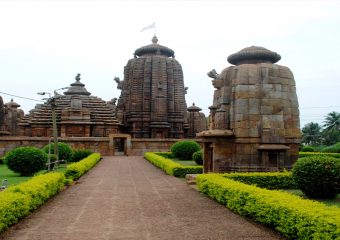
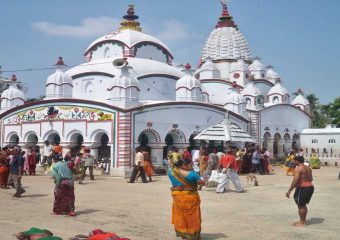
Chandaneswar Temple is a prominent Shiva temple in Odisha, India, located in Chandaneswar, Baleswar district. On the first day of the Odia calendar, Pana Sankranti (Odia Hindu solar New Year), a large annual fair is held on the site. During this time, the temple attracts a large number of Indian pilgrims.
An Odisha famous “Chadak Mela/Chaitra Mela/Udaa” is held every year in the month of ‘Chaitra’ (from 14 March to 14 April). It will last for 13 days (13 Arghya to 1 Arghya discounting). Paita is accepted by Bhaktas (devotees) (pabitrata). The Bhaktas come from all over the country with their ‘manaskamana.’ The Bhaktas rise in number from the 5th Arghya to the 3rd Arghya. Approximately 3 to 4 lakh Bhaktas exclusively perform their Arghyas (prayer) at night.
Chandaneswar is well-known for its Lord Siva temple. The exquisite white marble house of worship, built in the traditional Kalinga Architecture style of Old Odisha temples, resounds with Hindu mythological stories and sculptural depictions. Swayambhu is claimed to be the Shiva Linga here (or self-originated). This sacred temple’s main feature is a black figure of Nandi. A huge number of worshippers can always be found in the vicinity of the shrine.

Location:
Chandaneshwar is located in the Odisha district of Balasore. Transport is available on a regular basis from Jaleswar in Odisha and Digha in West Bengal.
Taptapani

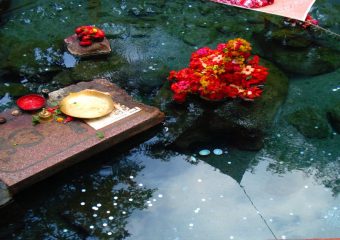
Taptapani is well-known for its sulfur-rich spring water. The next town is Mohana, which is located in the Gajapati district and is about 16 kilometers distant. That is also implied by the name “Taptapani.” The words “tapta” and “pani” signify “hot” and “water,” respectively.
The medicinal benefits of the hot water from Taptapani’s natural spring can be enjoyed by bathing in the pond made next to the spring. The hot spring is located at the crest of a hill on the eastern side of the Eastern Ghat, surrounded by a beautiful green forest with a diverse range of flora and wildlife. Taptapani’s indigenous cultures and gorgeous landscape are also popular draws. A deer park is also managed by the forest service.

Transport

Taptapani has easy access to major cities in Odisha, including Bhubaneswar, Berhampur, Cuttack, Jeypore, Rayagada, and Malkangiri. Berhampur Railway Station, located on the Howrah-Chennai mainline, is the nearest railway station.

Accommodation

Tourists can only stay at the expansive Panthanivas in Taptapani. The two AC suites share a balcony and include a large bedroom, dressing area, and bathroom with a little swimming pool fed by the hot springs’ warm water. The villas look out over a lush valley of varying colors of green. Anyone can sit here for hours at a time. The Dining Hall is advantageously located between two mountain fold crests. The kanduni devi temple is situated on the edge of an underground hot spring. From there, two smaller tanks, one for men and one for women, provide hot water bathing facilities. A deer park is also managed by the local forest authority.

Ananta Vasudeva Temple

Ananta Vasudeva Temple is a prominent Hindu temple located on the eastern bank of Bindu Sarovar in Bhubaneswar, around 4.5 kilometers from Bhubaneswar Railway Station, Odisha in India, dedicated to Lord Krishna, an avatar of Lord Vishnu. The temple was built in the thirteenth century, and it has the entire murtis of Krishna, Balarama, and Subhadra. Balarama stands beneath a seven-hooded serpent, while Subhadra holds a jewel pot and a lotus in her two hands, her left foot resting on another jewel pot, and Krishna wields a mace, chakra, lotus, and conch. The temple was built during the time of King Bhanudeva during the reign of Chandrika Devi, the daughter of Anangabhima III. In the British Museum’s collection, there is a commemorative inscription that marks the temple’s foundation.

The original image of Vishnu appears to have been worshipped on the site of Ananta Vasudeva’s grand temple, which was built in the 13th century A.D. In the 13th century, Queen Chandrika of the Eastern Ganga dynasty was inspired to build a new temple – the temple of Ananta Vasudeva – in this location. This Vishnu image had to have been installed in an old temple. The Marathas, who extended their empire to the Mahanadi River, were in charge of renovating the Vishnu temple in Bhubaneswar in the late 17th century.

The temple is similar to the Lingaraj temple in appearance, but it has vaishnavite (Lord Vishnu-related) sculptures. The temple includes longitudinal bands of miniature shikharas (shrines) that are identical to those found at Lingaraj temple, with the exception that the number of shikharas forming one longitudinal band is only three in this case. Each temple in Bhubaneswar has a different kind of sculpture on the outer walls. The majority of female statues on the temple walls are extremely ornate and unoriginal.

Unlike the images of the Jagannath Temple in Puri, the idols discovered in the garbhagrha (sanctum sanctorum) of the temple have complete structure. Unlike the Puri temple, the shrimurtis (idols) here are made of black granite stone rather than wood. The city is known as Chakra kshetra (round place) only because of this temple, whereas Puri is known as Shankha kshetra (curved place).

Brahmeswara Temple

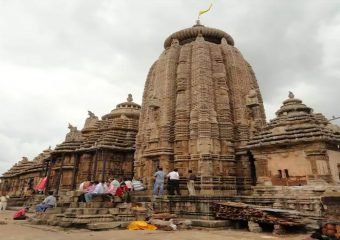
Brahmeswara Temple is a Hindu temple dedicated to Shiva. This Temple is located 5 kilometers from the Bhubaneswar Railway Station Odisha, India. It was built at the end of the 9th century CE and is richly carved on the inside and outside. The use of inscriptions that were originally on the temple allows us to date this Hindu temple fairly accurately. They are now lost, but records of them have been preserved, preserving information from around 1058 CE. The temple was built by his mother Kolavati Devi in the 18th regnal year of the Somavamsi king Udyotakesari, which corresponds to 1058 CE.

Historians place the temple to belong to the late 11th century, as evidenced by an inscription brought from Bhubaneshwar to Calcutta. The temple was built by Kolavatidevi, the mother of Somavamsi king Udyota Kesari, according to the inscription. It was constructed with four Natyasalas in Ekamra at a location known as Siddhatirtha (modern-day Bhubaneswar). The inscription was discovered in the 18th renal year of Udyotha Kesari, which corresponded to 1060 CE. Because the inscription is no longer in its original location, historians speculate that it may refer to another temple, but based on the location and other features specified, it is determined that the inscription belongs to the temple. Another point raised by Panigrahi is that the four cardinal temples are Angasalas (associate temples) rather than Natyasalas (dance halls) as the inscription indicates.

The temple is classed as a panchatanaya temple because, in addition to the main shrine, there are four minor shrines located in the temple’s four corners. In comparison to its predecessors, the temple has a perfectly developed construction due to its later origin. The temple’s vimana is 18.96 meters (62.2 feet) tall. [2] The temple was constructed using conventional architectural methods of wood carving but on stone. The structures were constructed in the shape of a full-volume pyramid, then carved on the inside and outside. The property is 208.84 square meters in size, while the temple is 181.16 square meters.