Barehipani Waterfall

Barehipani waterfall is one of the tallest waterfalls in India, which is situated inside the famous Similipal national park in the district of Mayurbhanj, Odisha. The total height of two-tier falls is 217m and is the second-highest waterfall in Odisha. The total height of Barehipani falls is 399 meters (1,309 feet). The highest single drop is 259 meters (850 feet).

Waterfalls are located on the Budhabalanga river flowing over Meghasuni mountain in east ghats on 21.932759n 86.380145e. The nearest railway station is in Baripada. Joranda waterfall is situated nearby. It is 120 km away from the city of jashipur.

The total height of Barehipani falls is 399 meters (1,309 feet). The highest single drop is 259 meters (850 feet).

Huma Temple

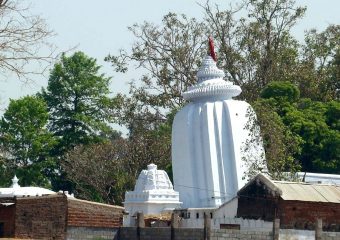
The Huma Temple in India is one of the only two-pronged temples in the world. It is located in the state of Odisha in India in a village situated on the Banks of Mahanadi from Sambalpur to 23 km south. The temple is dedicated to the Hindu god Bimleswar.

 It is not known that this structure is bent by design or for some other reason. Though the building is tilted, the apex of the temple is perpendicular to the ground.

ARCHITECTURE:

Bhairavi Devi Temple is located to the left of the main temple and Bhairo Temple is located to the right of the main temple. According to historical records, this temple was built by Anangbhim Deva III, the king of the Ganga Dynasty. The reconstruction or restoration of the temple was done by King Bailar Singh (1660-1690), the fifth Chauhan king of Sambalpur was done. The remaining temples were built during the reign of King Ajit Singh (1766-1788 A.D.) of Sambalpur.

This temple is located on the rocky outcrop on the bank of the Mahanadi River. The bending may not be considered as technological flaws at the time of construction and it is also not easily accepted that the temple may have receded from a weak foundation. Perhaps the inner displacement of rocky beds is possible due to flood currents or earthquakes in the Mahanadi River.

The foundation of the shrine has slightly deviated from its original setting and consequently, the structure of the temple has been tilted. This trend has fascinated historians, sculptors, and other researchers. Surprisingly, the major temple is tilted in one direction while the other smaller ones receded in other directions. Within the temple complex, that is, within the boundaries of the temple, everything is in a sloping condition, including the boundaries themselves, and villagers and priests say that the attitude of inclination has not changed in the last 40 or 50 years. The tilt is a geological reason. The rock below may be uneven in structure. The angle of inclination is 13.8°.

LEGEND:

It is said that Shiva’s worship was started by a milkman who crossed the Mahanadi every day and went to a place on the bank where the rock had come out. Here he turned down his milk – bucket which was soon consumed by rock. This miraculous circumstance led to inquiries, which ended in the making of the present temple

FESTIVALS:

In March every year, an annual fair takes place on the floor of the temple. A large crowd gathers in this fair, in which foreign tourists also participate. Here is a special type of fish called ‘Kudo’ fish; they are often fed by visitors. It is believed that anyone catching a Kudo fish turns into stone by a curse, the temple has a stone idol of a woman cutting a Kudo fish, said to be influenced by the curse and turned to stone


Khandadhar Falls

Khandadhar falls is situated in Nandapani of Bonaigarh in Sundargarh district, the state of the Indian state of Odisha. It is India’s 12th highest waterfalls and the second highest in Odisha. It resembles a sword hence the name Khanda (Sword) Dhara Falls. A small stream (which is korapani Nala) plunges below the height of 244 meters (801 feet) in a single drop.

LOCATION:

The Khandadhar waterfall far from Rourkela via Bonaigarh is 104 km(65mi), and from Keunjhar is 132 km(82mi).

HISTORY:
There is an interesting legend among the Pauri Bhuiya tribal living in the vicinity of Khandahar. Legend has been reproduced from outlook (magazine). A Pauri Bhuiya legend explains how his mountain became so munificent. At one time in the Sundergarh branch of the community, there was the greedy goddess who used to eat trees, soil, and all other things. In despair, Pauri Bhuiya placed him on a rock which he ate – made a deep hole through which the Khandahar (dividing rock spring) turned out. So they had water. Then a pair of the community went to the eastern end of the Khandahar mountain range or to meet one of their relatives in Keonjhar. Their potential hosts were far away but a heap of grains was left out and surprisingly, birds were not even eating it. Inside the heap, the couple searched for a little goddess, Kanta Kumari, who was the savior of the prosperity of the region. They stole him and brought him back to Sundargarh, and so her reward became theirs.

EFFECT OF MINING:

The Kalinga commercial corporation limited operates the kurmitar mines located in the Khandahar hill range in 133 hectares. It exports manganese ore to China to iron ore and Korea. At the turn of the mountain top current, Khandadhara falls are partially dry. There are mines in the area spread 1,212 hectares has state-owned Odisha mineral corporation It has signed agreements with Adhunic Metaliks and Rexon Strips for the supply of iron ore. The government of Odisha intends to give 2,500 hectares of the lease to POSCO India. There has been local opposition and the matter has reached the courts. The court verdict is awaited till 2012.

Shri Nrusinghanath

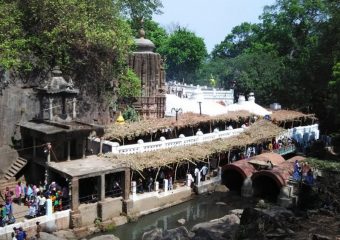
Shri Nrusinghnath is a Temple in Odisha in India which is located at the bottom of the Gandhamardana hills near Pikakamal, Baragarh. The king of Patna, Baijal Dev, had laid the foundation of this historic temple at the beginning of the 15th century.

Its height is only 45 feet, which is divided into two parts: the first is the seat of Lord Nrusinghanatha, the second is allotted to Jagmohan. The chamber has 3 gates and is supported by every 4 columns.

HISTORY:

Six hundred years ago, in the book called “Nrusingha Charitra” of Odiya, a lady Jamuna Kandhurni composed a poem that sang of the glory of Marjara keshri in respect of the oppression and suppression of the atrocities of the musician’s demon. This temple is revered with mythological history from that day. This story symbolizes the base of the monstrous viciousness of tyranny and torture which never dares to overtake and since then it is protected by Lord Nrusinghanath Marjra Keshari. According to the Chinese Traveler Huen Tsang, this place was the center of instruction in Buddhist scriptures. Lord Nrusingnath is one of the most adorable gods of Odisha and on the 14th day of the bright fortnight in the month of Vaisakha a great fair is held in his honor. According to Devanagiri and Odia inscriptions, this temple was built by BIjal Dev at the starting of the fifteenth century AD.

TOURIST:

Chal Dhar, Bhim Dhar, Sita Kunda, Panchupandab, Kapil Dhara, Supta Dhar, Satyaamb, Bhima Madua, Happy Point also you can visit here. Nursinghnath Temple is located 110 KMS west in Baragarh and 164 km from Sambalpur. The nearest railway station is Khariara road railway station. A beautiful garden is also built near the temple, where a separate avatar of Lord Krishna is shown and an image of hanuman of 28 feet is also made inside the center of the garden